
Search
568 items
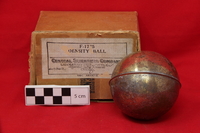
Cenco Density Ball and Box
Density Ball floats in tap water, sinks in water at 85 F or higher. Label on box contains CENCO trademark indicating ball was purchased after 1909; otherwise, date is unknown.
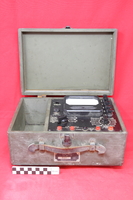
Signal Corps Test Unit I-176
Signal Corp Test Unit I-176, serial no. 0238, containing a Triplet Elec. Inst. Co. multimeter. The Physics Department probably obtained this unit from army surplus in the decades following World War II.
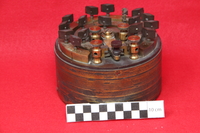
L. Bradley Circular Resistance Box
Circular resistance box manufactured by L. Bradley & Co. in Chicago. Patent date is Jan. 7, 1873. Construction of box consistent with 1870s technology. Box was probably used in trouble shooting telegraph or possibly telephone lines. We have no further information about the box.
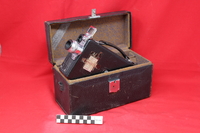
Cine-Kodak Model K 16 mm camera
Kodak manufactured the Cine-Kodak Model K 16 mm motion picture camera from 1930 until 1946. This camera accomodates up to 100 foot rolls and a Kodak astigmatic focusing 25 mm f/1.9 lens. The mechanism is spring driven using a side-mounted winding crank. We do not know the acquisition date.
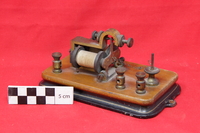
MESCO Pony Telegraph Relay
Standard Pony Telegraph Relay manufactured between 1900 and 1910 and listed in the MESCO 1905 catalog for use as burglar alarm for a given length of telegraph line. The list price is between $3.00 and $4.00 depending on the coil resistance.
MESCO states that the relay uses much less power to operate than a sounder of similar resistance.
A resistance measurement was imposible as this device has a break in the coil windings.
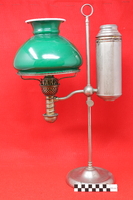
Student’s Oil Lamp
This lamp was used by Prof George L. Pierce while studying at Oberlin and given to the museum by Wayne and Clara Denny. Grinnell students used oil or gas lamps until the mid 1890’s.

Goodnow Hall
Located on the Grinnell College campus and constructed in 1885, Goodnow Hall was the first building constructed after the devasting tornado of 1882. Goodnow was built with quartzite rock, at the time a rare material. The architect was Stephen C. Earle; E.A. Goodnow provided the $10,000 required for the construction.
Initially designed as a library and observatory, it became the home of the physics and mathematics departments following the construction of the Carnegie library in 1904. A wooden cornice from the original library is on display in the Physics Museum
The dome on the tower of Goodnow housed the Hsieh telescope, an Alvan Clark eight-inch refracting instrument. Two precision Seth Thomas clocks, one set on sideral time and the second on solar time, in conjunction with a Fauth transit telescope, a Fauth chronograph, provided accurate timekeeping. The eight-inch objective lens on display in the museum is the only remaining remnant of the telescope.
The small transit hut with the slotted roof beside Goodnow contained the transit telescope with telegraph connections to the Goodnow clock room with its two precision clocks and chronograph. All are on display in the museum. The Warner-Swasey filar micrometer used with the Hsieh telescope is also displayed in the museum.
In 1926 leakage problems forced the removal of the tower observatory dome and astronomy disappeared from Grinnell's curriculum until the 1960's. The current Grant O. Gale observatory with its 24-inch telescope was dedicated in 1984.
After the physics department moved to the new Science Building, Goodhow housed the psychology department from 1954 until 1988. Following a major restoration project in xxx which included replacing the limestone belts on the tower, the anthropology department moved to Goodnow. In 2019 after the anthropology department moved to the new Humanities and Social Sciences Center, Goodnow awaits its next occupant.


